During my week off, I finally got around to reading Hella Winston's Unchosen: The Hidden Lives of Hasidic Rebels. It's a fascinating book and I recommend it to Orthodox Jews, non-Orthodox Jews, and anybody who's interested in the human tragedies and stories of survival and renewal that it contains.
As most of my formerly and currently Orthodox Jewish readers know, the book is about Hasidim who rebel against the lifestyle in which they were born and raised. Most of them continue to pretend to be "normal" Hasidim, out of fear of hurting their loved ones or losing their communities, their families, and/or their livelihoods. It's very moving and, whether you believe the Hasidic way of life is fundamentally right or wrong, you will recognize that the way the community treats those who don't fit desperately needs to be addressed.
Unchosen is not a systematic study of the Hasidic world as a whole and as such doesn't provide evidence for how widespread the problems her subjects face are. However, one of the people in the book, who himself remains frum, estimates that he personally knows 100 Hasidic rebels who lead hidden lives, and that he suspects there are many more, perhaps 500.
Almost all of the rebels in the book remain, to some extent, attached "to the religion and to certain elements of Hasidic culture, [but] also feel oppressed by their community's rigid rules, behavioral restrictions, and social scrutiny." Indeed, it's striking how many of the problems the rebels face stem from "rigid rules, behavioral restrictions, and social scrutiny" which is tangential at best to the actual religion. For example, although Hasidic clothing is mostly custom rather than religious rule, rebels who dressed a little bit differently were (verbally) abused by relatives and other Hasidim. All of the rebels in the book who remained in their communities lived in fear of being found out, not because they were embarrassed, but because they feared retribution in the form of rejection from family and livelihood, damaging their siblings' or children's chances at making good shidduchim*, or, in some cases, of beatings by so-called "enforcers."
The Hasidic community which appears in this book (and again, the book is not an attempt to study the community quantitatively but rather shows the community through the rebels' eyes) is one which seems to be preoccupied with what everybody else thinks and does. "[E]ven those who identified themselves as contented members of their communities nonetheless expressed a great preoccupation with what others in the community would think, and say, and do in the face of even hypothetical nonconformity... while I tried my best to remain open to all points of view, I couldn't help feeling angered by the treatment many had been subjected to, merely for asserting their individual desires, or daring to question."
Furthermore, many of the rebels who wanted to leave the community (as opposed to those who wished to remain but live more freely) were hindered by a lack of education. Many barely know English, and very few knew much math beyond basic arithmetic. Few have legitimate high school diplomas. The Hasidic rebels also lack social education. They don't know how to relate to non-Jews or even non-Hasidic Jews. They're not comfortable relating with the opposite sex. They don't understand mainstream American social norms or expectations. Some, who have great difficulty making the transition to the non-Hasidic world and aren't used to having so few rules, fall prey to drug problems or risky sexual behavior.
Malkie Schwartz, who is a prominent figure in Unchosen, was able to get herself into a college and successfully transition out of the Hasidic community. She credits her (late) secular grandmother for this achievement, for providing her with a place to stay and the necessary support. Malkie, following (but drastically changing) the lubavitcher tradition of serving others, opened an organization called Footsteps (previously discussed here) which provides "educational, vocational, and emotional support to those seeking to enter or explore a world beyond the insular, ultra-religious environments in which they were raised." Footsteps provides English tutoring, GED high school equivalency preparation, and help with college and job applications.
Many religious readers will find solace in making a distinction between the people and the religion. In the conclusion, Winston addresses this idea: "[M]any people I spoke with liked to claim, as a kind of defense, that it is not the religion itself, but religious people who are the problem. This may be a more intellectual than substantive distinction, however. Religion, of course, does not exist in a vacuum, and even those who believe that religious laws were handed down from God acknowledge that it has been up to human beings to interpret them and carry them out. The lives of those described in this book unfolded within actual Hasidic communities, after all, not in some theoretical space."
* "Shidduchim" are matches made by matchmakers. Typically, in the communities Winston writes about, matches are made by matchmakers. The couple will meet each other two or three times and decide whether to get married. Although nobody can be forced to marry, it's uncommon to reject more than a couple potential spouses. Hasidim seem to live in fear of damaging their children's or sibling's potential shidduchim, since having a relative who leaves the community or doesn't quite fit in may seriously lower the quality of potential spouses. Similarly, the children of ba'alei tshuvah, or formerly non-Hasidic Jews who became Hasidic, will be matched with other children of ba'alei tshuvah or other people considered lower status.
Saturday, December 24, 2005


Sunday, December 18, 2005
Friday, December 16, 2005
The Bat, the Bird, and the Flatfish
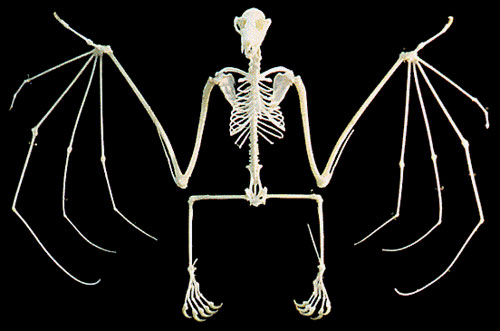

If animals were designed by
Bonus question: Was

Wednesday, December 14, 2005
Creationists Say, "Stop Calling Evolution 'Just a Theory'"
The primary authority for Answers in Genesis is the infallible Word of God, the Bible (see Q&A Bible). All theories of science are fallible, and new data often overturn previously held theories. Evolutionists continually revise their theories because of new data, so it should not be surprising or distressing that some creationist scientific theories need to be revised too.
The first article on this page sums up what the creationists’ attitude should be about various ideas and theories. The other articles provide examples of arguments that should no longer be used; some arguments are definitely fallacious, while others are merely doubtful or unsubstantiated. We provide brief explanations why, and/or hyperlinks to other articles on this Web site with more detailed explanations. We don’t claim that this list is exhaustive—it will be updated with additions and maybe deletions as new evidence is discovered. Many of these arguments have never been promoted by AiG, and some have not been promoted by any major creationist organization (so they were not directed at anyone in particular), but are instead straw men set up by anti-creationists. --Answers in Genesis [emphasis added]
I just stumbled across this fascinating page on the huge creationist organization Answers in Genesis's website. Although it is a strong advocate of young-Earth creationism (i.e. God created the Earth less than 10,000 years ago) it lists a number of arguments that creationists should not use since they are either untrue or "doubtful."
Interestingly, I've seen many of them used by creationists on my blog:
"Arguments we think creationists should NOT use"
‘No new species have been produced.’
‘Archaeopteryx is a fraud’
‘There are no beneficial mutations.’
‘Ron Wyatt has found Noah’s Ark’
"What arguments are doubtful, hence inadvisable to use?"
‘There was no rain before the Flood.’
‘Evolution is just a theory.’
‘The speed of light has decreased over time’
‘There are no transitional forms.’
‘Creationists believe in microevolution but not macroevolution.’
So, my creationist readers, if you won't believe me about these claims, perhaps you'll believe Answers in Genesis.
My non-creationist readers, I highly recommend checking the site out anyway -- it's fascinating. For example, I learned about Dr Russell Humphreys, a "creationist physicist" who "was inspired to develop a new creationist cosmology which appears to solve the problem of the apparent conflict [of being able to see millions of light-years away even though he doesn't believe that the speed of light has slowed significantly] with the Bible’s clear, authoritative teaching of a recent creation." I also learned that there is a International Conference on Creationism and that they claim to value the concept of peer review.
Tuesday, December 13, 2005
Diebold CEO Resigns!
The resignation of Diebold Inc. Chief Executive Walden W. O'Dell was cheered on by Wall Street Tuesday as a move seen giving the company a fresh start from leadership marred by controversy...
The company was thrust into the center of controversy during the 2004 presidential election campaign, after O'Dell wrote in a Republican Party fundraising letter that he was "committed to helping Ohio deliver its electoral votes to the president next year." The Canton, Ohio-based company is among the nation's biggest suppliers of paperless, touch-screen voting machines. (Business Week)
That Diebold voting machines were allowed to be used without a paper trail is obscene. There is no way to verify that the vote you cast is counted for the candidate you voted for in these machines. You just have to trust Diebold, not only to be honest, but to create the perfect, bug-free system. Anybody who has ever used a computer knows that that's impossible. Even if the CEO of one of the "largest suppliers of paperless, touch-screen voting machines" hadn't promised to deliver the election to one of the candidates, there is simply no excuse for such stupidity. What's more important than the trustworthiness of our elections?
This is not a Republican or a Democratic issue; it's an American one. I say this as a citizen and as a professional software engineer: No paperless voting machines!
Remember what Stalin said: "The people who cast the votes don't decide an election, the people who count the votes do."
(via slashdot)
Subscribe to:
Posts (Atom)