Showing posts with label god. Show all posts

Sunday, May 17, 2009

This War Has Nothing To Do With Religion!


Right-wing bloggers mocked me and everybody else who threw around words like "theocons" and "religious nuts" with regard to the Bush administration. They roundly dismissed claims that Bush said that God told him to invade Iraq. They said we were overreacing when Bush referred to the war as a "crusade." They scoffed at the notion that there's any connection between religiosity and hawkishness in America. (I guess the immense overlap between Iraq War supporters and the religious right is a coincidence. And the only reason Orthodox Jews are the only Jews who vote Republican is that they are the most rational. Uh-huh.)

And yet: Donald Rumsfeld put insane Bible verses (and chickenhawk war-porn) on the cover sheets of his top-secret intelligence briefings in the days surrounding the U.S. invasion of Iraq:


These are not powerpoint presentations put together by bored 12 year olds at Bible camp. These were the covers of intelligence briefings by the Secretary of Defense given to the President of the United States of America.

This country is so topsy-turvy. Americans say they'd never vote for an atheist, and being a religious fanatic is a plus. Gays in the military are required by law to hide their orientation (and consequently their families and loved ones) because homosexuality is something shameful and dangerous, but being a religious wacko will help you get promoted. Supposed followers of Jesus -- the Prince of Peace who was tortured to death in a "stress position" -- mindlessly support torture and atheists are called immoral or worse.

Thursday, October 09, 2008

Yom Kippur Thoughts of the Day

Two thoughts:

The Meaning of Yom Kippur

I just had a discussion with a fellow ex-Ortho about what Yom Kippur means to us now. For him, it's an opportunity to act like it's just a normal day and to not let any of the brainwashing he went through as a kid make him feel guilty. For me, it's kind of like a happy day where I get to remember each year where I have come from and what I don't have to do any more.

God as Big Brother

Imagine that we atheists are right that God does not exist.

That means that billions of people all over the world are teaching their children that an imaginary being is following them everywhere they go and watching everything they do, even listening to their thoughts, and he's going to judge them for all of it. And they behave differently because of this belief. They whisper words of thanks and prayer and feel guilty when they have a "bad" thought and try to be good little boys and girls all the time and sometimes they think they hear him talking to them. And most of them go their whole lives believing that. It's an amazingly creepy feat of social engineering and behavior modification.

Wednesday, September 24, 2008

Repost: This is Your Brain on God

Holy Hyrax's recent post made me dig up this old post:

It seems that I'm doing a good portion of my blogging these days in the comments section of other people's blogs. In particular, I've been having some interesting discussions with Mark at Pseudo-Polymath.

This morning, I wrote a comment I'd like to post here as an entry.

Mark posted about an experience Catholic writer Richard John Neuhaus had:

It was a couple of days after leaving intensive care, and it was night. I could hear patients in adjoining room moaning and mumbling and occasionally calling out; the surrounding medical machines were pumping and sucking and bleeping as usual. Then, all of a sudden, I was jerked into an utterly lucid state of awareness. I was sitting up in the bed staring intently into the darkness, although in fact I knew my body was lying flat. What I was staring at was a color like blue and purple and vaguely in the form of hanging drapery. By the drapery were two "presences." I saw them and yet did not see them, and I cannot explain that. But they were there, and I knew that I was not tied to the bed. I was able and prepared to get up and go somewhere. And then the presences — one or both of them, I do not know — spoke. This I hear clearly. Not in an ordinary way for I cannot remember anything about the voice. But the message was beyond mistaking: "Everything is ready now."


Mark correctly points out that many people throughout history have described similar experiences. He then goes on to imply, however, that such experiences provide evidence for religion:

But, Judaism, Christianity, Islam, and the other world religions all depend crucially on revelation as part of their history as well as their perception who is God and what does He want with Man.


Mark believes that skeptics think "no experience of Theophany is valid. That every one of the millions of experiences of this sort are all fraud or insanity (temporary or less so.)" Since Neuhaus's account appears to be neither fraudulent or evidence of insanity, therefore, it must reflect a legitimate revelation experience. Therefore, there is some evidence for the supernatural.

In my response, I point out that there are other options besides insanity and fraud, and in fact there are more convincing explanations for such experiences than supernatural entities:

I don’t think you quite understand my position on what you call "revelation." I believe, as do you, that such experiences as Neuhaus’s happen. I further believe, as do you, that they happen to people who are sane.

I disagree on the cause of such phenomena. The Wired Article This Is Your Brain on God describes an experiment in which researchers direct electromagnetic fields towards the temporal lobes in certain patterns and generate what you would call a revelation experience:

I’m taking part in a vanguard experiment on the physical sources of spiritual consciousness, the current work-in-progress of Michael Persinger, a neuropsychologist at Canada’s Laurentian University in Sudbury, Ontario. His theory is that the sensation described as “having a religious experience” is merely a side effect of our bicameral brain’s feverish activities. Simplified considerably, the idea goes like so: When the right hemisphere of the brain, the seat of emotion, is stimulated in the cerebral region presumed to control notions of self, and then the left hemisphere, the seat of language, is called upon to make sense of this nonexistent entity, the mind generates a “sensed presence.”

Persinger has tickled the temporal lobes of more than 900 people before me and has concluded, among other things, that different subjects label this ghostly perception with the names that their cultures have trained them to use - Elijah, Jesus, the Virgin Mary, Mohammed, the Sky Spirit. Some subjects have emerged with Freudian interpretations - describing the presence as one’s grandfather, for instance - while others, agnostics with more than a passing faith in UFOs, tell something that sounds more like a standard alien-abduction story.

It may seem sacrilegious and presumptuous to reduce God to a few ornery synapses, but modern neuroscience isn’t shy about defining our most sacred notions - love, joy, altruism, pity - as nothing more than static from our impressively large cerebrums. Persinger goes one step further. His work practically constitutes a Grand Unified Theory of the Otherworldly: He believes cerebral fritzing is responsible for almost anything one might describe as paranormal - aliens, heavenly apparitions, past-life sensations, near-death experiences, awareness of the soul, you name it.


We’ve known for millenia that our minds are tricky things. There are scores of drugs which affect our perceptions and beliefs. If you drop some acid and see your chair talking to you, would you consider it revelation?

Furthermore, the various testimonies of people who’ve undergone such “revelations” contradict each other. Some see Mohammed — you, as a Christian, wouldn’t believe that to be a legitimate revelation experience, right? The most you could say is that there is some truth to the experience, but the person is interpreting it according to his or her own worldview.

Well, why not take it one step farther and say that everybody who undergoes such an experience is interpreting it according to his or her own worldview? Neuhaus experienced two presences and heard a sentence. He added the interpretation of who the presences were and what the sentence meant.

Surely Neuhaus was on medication and was in an unusual medical condition as well. The whole thing could have been an unusually lucid dream. For all I know, the two figures could have been a real doctor and a nurse saying that everything was ready for a procedure.

Once, when my middle-aged, normally sane father was in the hospital, he woke up from a nap convinced that he had to rush to the nearby university during the Final Four game because he was on their basketball team and they needed him desperately. Another time, free from sickness or medication, my father had a strong premonition that he was going to win the lottery. Normally a skeptical person who had never bought a lottery ticket in his life, he rushed out to buy one. He didn’t win.


I ended my comment there, but I'd like to post a few more excerpts from the article, which you should read in full:

Technically speaking, what's about to happen is simple. Using his fixed wavelength patterns of electromagnetic fields, Persinger aims to inspire a feeling of a sensed presence - he claims he can also zap you with euphoria, anxiety, fear, even sexual stirring. Each of these electromagnetic patterns is represented by columns of numbers - thousands of them, ranging from 0 to 255 - that denote the increments of output for the computer generating the EM bursts.

Some of the bursts - which Persinger more precisely calls "a series of complex repetitive patterns whose frequency is modified variably over time" - have generated their intended effects with great regularity, the way aspirin causes pain relief. Persinger has started naming them and is creating a sort of EM pharmacological dictionary. The pattern that stimulates a sensed presence is called the Thomas Pulse, named for Persinger's colleague Alex Thomas, who developed it. There's another one called Burst X, which reproduces what Persinger describes as a sensation of "relaxation and pleasantness."


Here's the author's description of his own experience:

When the door closes and I feel nothing but the weight of the helmet on my head and the Ping-Pong balls on my eyes, I start giving serious thought to what it might be like to "see" God, artificially produced or not. Nietzsche's last sane moment occurred when he saw a carter beating a horse. He beat the carter, hugged the horse while sobbing uncontrollably, and was then carried away. I can imagine that. I see myself having a powerful vision of Jesus, and coming out of the booth wet with tears of humility, wailing for mercy from my personal savior.

Instead, after I adjust to the darkness and the cosmic susurrus of absolute silence, I drift almost at once into a warm bath of oblivion. Something is definitely happening. During the 35-minute experiment, I feel a distinct sense of being withdrawn from the envelope of my body and set adrift in an infinite existential emptiness, a deep sensation of waking slumber. The machines outside the chamber report an uninterrupted alertness on my part. (If the researchers see the easily recognized EEG pattern of sleep, they wake you over the speakers.) Occasionally, I surface to an alpha state where I sort of know where I am, but not quite. This feeling is cool - like being reinserted into my body. Then there's a separation again, of body and soul, and - almost by my will - I happily allow myself to drift back to the surprisingly bearable lightness of oblivion.

In this floating state, several ancient childhood memories are jarred loose. Suddenly, I am sitting with Scott Allen on the rug in his Colonial Street house in Charleston, South Carolina, circa 1965, singing along to "Moon River" and clearly hearing, for the first time since then, Scott's infectiously frenzied laughter. I reexperience the time I spent the night with Doug Appleby and the discomfort I felt at being in a house that was so punctiliously clean. (Doug's dad was a doctor.) I also remember seeing Joanna Jacobs' small and perfect breasts, unholstered beneath the linen gauze of her hippie blouse, circa 1971.

Joanna was my girlfriend when I was 14. When I was sent off to boarding school, she and I recorded cassette tapes to one another. As a teenager, Joanna was a spiritual woman and talked a lot about transcendental meditation. Off at boarding school, I signed up and got my mantra from the Maharishi Mahesh Yogi, right around the time Joanna dropped me to move on to a tougher crowd.

If I had to pin down when I felt this dreamy state before - of being in the presence of something divine - it would be back then, in the euphoric, romantic hope that animated my adolescent efforts at meditation. That soothing feeling of near-sleep has always been associ-ated with what I imagined should have happened between Joanna Jacobs and me. Like the boy in James Joyce's The Dead, Joanna was a perfect memory - all the potential of womanly love distilled into the calming mantra-guided drone of fecund rest.

I'm not sure what it says about me that the neural sensation designed to prompt visions of God set loose my ancient feelings about girls. But then, I'm not the first person to conflate God with late-night thoughts of getting laid - read more about it in Saint Augustine, Saint John of the Cross, or Deepak Chopra.

So: Something took place. Still, when the helmet comes off and they shove a questionnaire in my hand, I feel like a failure. One question: Did the red bulb on the wall grow larger or smaller? There was a red bulb on the wall? I hadn't noticed. Many other questions suggest that there were other experiences I should have had, but to be honest, I didn't.

In fact, as transcendental experiences go, on a scale of 1 to 10, Persinger's helmet falls somewhere around, oh, 4. Even though I did have a fairly convincing out-of-body experience, I'm disappointed relative to the great expectations and anxieties I had going in.

It may be that all the preliminary talk about visions just set my rational left hemisphere into highly skeptical overdrive. Setting me up like that - you will experience the presence of God - might have been a mistake. When I bring this up later with Persinger, he tells me that the machine's effects differ among people, depending on their "lability" - Persinger jargon meaning sensitivity or vulnerability.

"Also, you were in a comfortable laboratory," he points out. "You knew nothing could happen to you. What if the same intense experience occurred at 3 in the morning in a bedroom all by yourself? Or you suddenly stalled on an abandoned road at night when you saw a peculiar light and then had that experience? What label would you have placed on it then?"

Point taken. I'd probably be calling Art Bell once a week, alerting the world to the alien invasion.

Wednesday, July 16, 2008

Quote of the Day: Do Skeptics Take Religion More Seriously?

And now we reach the group whom I perhaps love best, the skeptics, atheists and those who went off-the-derech. I know this group intimately well, for the simple fact that I understand the thought behind such a process.

There are different types of skeptics, atheists and irreligious Jews, of course, and far be it from me to force them all into one category. However, I believe I understand the two main derivations.

Those of you who left our religion due to the cruelty you had practiced upon you, the stifling nature of its constituency, the negative experiences you had and the fact that you were taught as a rule that you could not fulfill your dreams within its bounds, I have been you, and still am you at times.

And those of you who left after intellectual inquiry, having been persuaded by the science of our times, or the history, or whatever else it was you found which did not seem to stand before the Torah, I respect you. Because to me what this means is that your religion mattered enough for you to struggle, to invest the time and the energy into working through it and trying to prove it right, or more importantly, trying to follow wherever your search took you. And I believe that when you go up to God, you can honestly say that you tried your hardest to discover Him, and that your search was not an apathetic one, but a passionate one, fraught with meaning, and yet you did not. And so perhaps to the skeptic or atheist most of all, religion has meaning, for it was the fact that it had meaning which led him to question it and finally to leave it.

The Curious Jew, How to Love Every Jew.


I've always thought that us skeptics take religion more seriously than most religious people. If God exists, would He want us to search for the truth or to hold onto the religion we were born into for dear life, avoiding tough questions and settling on whatever apologetics we can?

Tuesday, May 13, 2008

Albert Einstein: Bible a Collection of Childish Stories

Maybe this will clear some things up for those confused by Einstein's unfortunate use of religious metaphor.
Albert Einstein, writing in 1954, dismissed Judaism and other religions as "an incarnation of the most childish superstitions," though he said he gladly belonged to the Jewish people and felt a deep affinity for the Jews' "mentality," excerpts published on Tuesday showed.

Einstein also said he saw nothing "chosen" about the Jews, and that they were no better than other peoples "although they are protected from the worst cancers by a lack of power."

The renowned physicist, who died a little more than a year after writing the letter, also had tough words for God and the Bible, according to the text published by the British The Guardian daily.

"The word God is for me nothing more than the expression and product of human weaknesses, the Bible a collection of honourable, but still primitive legends which are nevertheless pretty childish," the letter was quoted as saying. "No interpretation no matter how subtle can (for me) change this."

The letter, written in German in January, 1954 to philosopher Eric Gutkind, is to be auctioned in London on Thursday, the paper said. Written in Einstein's hand, the letter, which has been in private hands for more than half a century, reportedly could sell for as much as 8,000 pounds sterling.

Turning to Judaism, Einstein wrote that "For me the Jewish religion like all other religions is an incarnation of the most childish superstitions. And the Jewish people to whom I gladly belong and with whose mentality I have a deep affinity have no different quality for me than all other people.

"As far as my experience goes, they are also no better than other human groups, although they are protected from the worst cancers by a lack of power. Otherwise I cannot see anything 'chosen' about them."


Tip o' the hat to JP Perry.

Tuesday, November 20, 2007

This Just In: Herman Melville is God

It's true. I didn't want to believe it either, but the Moby Dick codes have proven it conclusively.


Via an anonymous commentator at DovBear's.

Sunday, August 26, 2007

If God Exists, Everything is Permitted Part II

In If God Exists, Everything is Permitted, I quoted Slavoj Zizek about how Dostoevsky had it backwards. Here's a real-life example:
Terrorists are turning more and more to crime to fund violence, according to a report from the Congressional Research Service... Oddly enough, religious groups may be more likely than political groups to turn to crime, since their sense of divine mission helps them convince themselves that any means is morally acceptable. (Islamic terrorists also find wiggle room by calling their depredations “economic jihad.”) Authorities suspect that profits from the sale of South American cocaine, Moroccan hashish, and Afghan opium support terror, but terrorist groups have also stooped to counterfeiting, bootlegging Viagra, sticking up jewelry stores, and heisting infant formula.

—“Terrorist Precursor Crimes: Issues and Options for Congress,” Siobhan O’Neil, Congressional Research Service (PDF)

Emphasis added. Via The Atlantic Monthly.

Monday, June 25, 2007

Obama on Religion and Spiritual Hunger

That God does not exist, I cannot deny. That my whole being cries out for God I cannot forget. --Sartre

David Brody, a correspondent for Pat Robertson's Christian Broadcasting Network, writes approvingly of Obama's public expression of faith. (Via Andrew Sullivan.)

While Obama's potential to siphon the hard-core Christian vote from the Republicans is an interesting story in itself, as is the question of whether we should worry about Obama's own mingling of faith and politics, Obama's description of the void that religion fills in people's lives deserves a post of its own:
There’s a hunger that’s deeper than that – a hunger that goes beyond any single cause or issue. It seems to me that each day, thousands of Americans are going about their lives – dropping the kids off at school, driving to work, shopping at the mall, trying to stay on their diets, trying to kick a cigarette habit – and they’re coming to the realization that something is missing. They’re deciding that their work, their possessions, their diversions, their sheer busyness, is not enough.

They want a sense of purpose, a narrative arc to their lives. They’re looking to relieve a chronic loneliness. And so they need an assurance that somebody out there cares about them, is listening to them – that they are not just destined to travel down that long road toward nothingness.

Saturday, May 19, 2007

The Problem of Evil: Top 12 Arguments

Via the Friendly Atheist, a list of the top 12 "excuses" for the existence of evil in a world created by God, created by August Berkshire of Minnesota Atheists and Atheist Alliance International. I find the problem of evil to be the most compelling argument against (a personal) God's existence as it's pretty much the only one that doesn't depend on Occam's Razor. I cannot reconcile the existence of natural disasters and other evil "acts of God" with any God I'd want to worship.

Anyway, here's the list:

If God is all-powerful, all-knowing, and all-loving, then why is there evil in the world?

For the sake of argument, I will concede the harm that humans do is a misuse of our free will, for which God cannot be blamed (although a good case can be made that a loving god would have stopped Hitler).

That still leaves us with genetic birth defects, genetic and acquired diseases, and natural disasters.

Here are “The Top Twelve Excuses” religious people use to attempt to explain away the horrible behavior of their god.

(1) Unknown greater good - The first excuse is that God must commit or allow some evil to occur to accomplish an unknown greater good.

But doesn’t that limit God’s knowledge and power? Doesn’t that say that God couldn’t think of a better way to accomplish his goals other than torturing innocent people?

(2) Evil is really God’s love - The second excuse is that what we perceive as “evil” is really an example of “God’s love.”

However, this is a definition of love we cannot comprehend because it is exactly the opposite of what we define love to be. Therefore we can’t know that “God’s love” is really love – we have to take someone’s unconvincing word for it.

If disease is an example of God’s love, shouldn’t we all try to get as sick as possible? Are doctors violating “God’s will” when they try to cure disease?

(3) Evil is needed to appreciate the good - The third excuse is that without evil we wouldn’t appreciate what’s good.

But couldn’t a god just give us an appreciation of what’s good? Why should we have to be tortured to appreciate the good?

Disease and natural disasters seem like wanton cruelty on the part of God. Without disease and natural disasters we could still be left to struggle with good and evil in terms of moral dilemmas and human actions.

(4) Blame the ancestors and blame the victim - The fourth excuse is that all evil that happens to us is our fault, either directly, or because of Adam and Eve.

This is known as “blaming the victim.” Typically, a victim of abuse believes that the more he or she is punished, the more he or she is loved.

But what did an innocent baby ever do to deserve a birth defect?

And what kind of justice is it that blames children for the sins of their long-dead ancestors?

(5) Evil is necessary for free will - The fifth excuse is that without evil we would have no free will and would be robots.

But what do birth defects, disease, and natural disasters have to do with free will? Do sick people have more free will than healthy people?

God has supposedly created a heaven where there is no disease. Are the people in heaven robots?

(6) The devil did it - The sixth excuse is that God isn’t really responsible for evil in the world, a devil is.

But who created the devil? And isn’t God supposed to be all-powerful? Can’t he stop the devil?

(7) Evil doesn’t last very long - The seventh excuse is that our miserable time on Earth is brief compared to an eternity in a wonderful heaven.

So what? Is that any excuse to torture people?

(8) Evil is necessary for compassion - The eighth excuse is that evil is necessary for us to learn compassion.

But if God wanted us to be compassionate, why didn’t he just make us that way? Why this sadistic scheme of torturing innocent babies to instill compassion in their parents?

(9) Suffering builds character - The ninth excuse is that suffering builds character.

While building character may sometimes require effort – such as helping others, studying, and sportsmanship – none of these threatens our lives.

And what kind of character is a baby supposed to be developing, who is born with a birth defect so severe that she will only live a few days?

(10) God is testing our faith - The tenth excuse is that evil is God’s way of testing our faith, like Job was tested in the Old Testament.

If this is true, what sense does it make to impose a “loyalty test” on an infant who dies from disease or natural disaster?

(11) The Creator is always justified - The eleventh excuse is that God is morally justified in tormenting people because he created them.

But this confuses the right to torture someone with the power to torture someone.

Do the parents who create a child have a right to torture that child? Does might make right?

(12) Evil necessary to prove God’s existence - The twelfth excuse is that the existence of evil proves the existence of God, that without a God-given sense of good and bad, we would not be able to identify some things as evil in the first place.

But can’t an all-powerful, all-knowing, all-loving god come up with a better way to prove his existence than by torturing us? Why not just reveal himself?

Conclusion - God has run out of excuses. He is either incompetent, indifferent, or cruel. Another way to reconcile the facts is to conclude that gods don’t exist at all.

Additional comments - If you had the knowledge and power of a god, would you have created birth defects, disease, and natural disasters? If not, then you are nicer than the god you believe in. This god should be praying to you for moral advice, rather than the other way around.

Would you take a syringe full of malaria and inject it into someone you love? And yet that’s exactly what God does to people he claims to love, using a mosquito as the syringe.

We humans spend a lot of time mopping up after God’s mistakes. Some say that God works through us. But the reason we have to do “the Lord’s work” is because “the Lord” isn’t doing it himself. And if we’re doing the work, shouldn’t we take the credit?

There is much unnecessary cruelty in nature. For example, when one male lion replaces another in a pride of lions, he kills the cubs of the previous male lion. Yet this type of behavior does not occur in other species. Thus, if a god designed this system, he is not above a little wanton cruelty from time to time.

Yes, many religious people do kind acts of charity. But why? Too often the answer seems to fall into three categories, which turn out not to be altruistic at all:

1) To use the recipient of aid as a pawn to bribe the helper’s way into heaven or avoid hell (or to achieve a higher reincarnation).

2) To use kindness to convert more people to the helper’s religion, because religions cannot be sustained by evidence and thus need as many like-minded people as possible to prop them up and quash self-doubt.

3) To attempt to maintain credibility in their religion by covering up the embarrassingly poor job done by their god, by claiming they are agents of God.

For those religious people who are kind for the sake of kindness, without reference to a god, that’s exactly what secular humanism is.

Bible Quotes - “I form the light and create darkness, I bring prosperity and create disaster; I, the Lord, do all these things.” (Isaiah 45:7)

“Is it not from the mouth of the Most High that both calamities and good things come?” (Lamentations 3:38)

“When disaster comes to a city, has the Lord not caused it?” (Amos 3:6)

Monday, April 30, 2007

Sometimes, Atheists Try to be Polite...

Other times, we just like to laugh.

Religion 101 Final Exam

Sample questions:
Which of the following is the most compelling evidence for the existence of an intelligent and loving Designer?

1. A Caribbean sunset
2. The screams of a baby seal as it is torn apart by a shark
3. The first time your perfect new baby smiles at you
4. The speed of the Ebola virus converting an African child's organs into liquid

You are a product tester and frequently bring your work home. Yesterday, while dressed in a flame resistant suit (up to 3,000 degrees) and carrying the latest model fire extinguisher, you discover your neighbor's house is on fire. As the flames quickly spread, you stand and watch your neighbor's new baby burn to death. Which of the following best describes your behavior?

1. All-powerful
2. All-knowing
3. All-loving
4. Mysterious

Which of the following is most likely to be true, and why?

1. Romulus was the son of God, born to a mortal human virgin
2. Dionysus turned water into wine
3. Apollonius of Tyana raised a girl from the dead
4. Jesus Christ was the son of God, born to a mortal virgin, turned water into wine, and raised a man from the dead

You are eating lunch at a crowded fast food restaurant, occupied mostly by children, when suddenly a gunman bursts in, screams "Do not question or test me," and sprays the room with bullets. Ten people are killed instantly, many more grievously wounded, but somehow you escape unharmed. His ammunition expended, the gunman collapses to the floor. What should you do?

1. Call the police and wait for them to arrive
2. Call the police and leave
3. Risk death by asking the gunman why he did it, even though he told you not to
4. Fall on your knees and give thanks and praise to the gunman for sparing your life

A great sadness has come into your life which you feel you cannot bear. A friend informs you of a free counseling service which has never failed to aid and comfort many others. You call the counselor; the phone rings and rings with no answer; you finally hang up. What is the most likely explanation?

1. The counselor is sitting by the phone but not answering in order to test your faith in him
2. The counselor always stands ready to hear your pleas for help, but sometimes the answer is "no"
3. The counselor will not answer because he wants you to profit by the spiritual strength that only comes through suffering
4. The counselor is not home

Saturday, April 07, 2007

Einstein on Religion, the Afterlife, Free Will, and Atheists

This is interesting:

Do you believe in God? "I'm not an atheist. I don't think I can call myself a pantheist. The problem involved is too vast for our limited minds. We are in the position of a little child entering a huge library filled with books in many languages. The child knows someone must have written those books. It does not know how. It does not understand the languages in which they are written. The child dimly suspects a mysterious order in the arrangement of the books but doesn't know what it is. That, it seems to me, is the attitude of even the most intelligent human being toward God. We see the universe marvelously arranged and obeying certain laws but only dimly understand these laws."

Is this a Jewish concept of God? "I am a determinist. I do not believe in free will. Jews believe in free will. They believe that man shapes his own life. I reject that doctrine. In that respect I am not a Jew."

Is this Spinoza's God? "I am fascinated by Spinoza's pantheism, but I admire even more his contribution to modern thought because he is the first philosopher to deal with the soul and body as one, and not two separate things."

Do you believe in immortality? "No. And one life is enough for me."

Einstein tried to express these feelings clearly, both for himself and all of those who wanted a simple answer from him about his faith. So in the summer of 1930, amid his sailing and ruminations in Caputh, he composed a credo, "What I Believe," that he recorded for a human-rights group and later published. It concluded with an explanation of what he meant when he called himself religious: "The most beautiful emotion we can experience is the mysterious. It is the fundamental emotion that stands at the cradle of all true art and science. He to whom this emotion is a stranger, who can no longer wonder and stand rapt in awe, is as good as dead, a snuffed-out candle. To sense that behind anything that can be experienced there is something that our minds cannot grasp, whose beauty and sublimity reaches us only indirectly: this is religiousness. In this sense, and in this sense only, I am a devoutly religious man."

...


But throughout his life, Einstein was consistent in rejecting the charge that he was an atheist. "There are people who say there is no God," he told a friend. "But what makes me really angry is that they quote me for support of such views." And unlike Sigmund Freud or Bertrand Russell or George Bernard Shaw, Einstein never felt the urge to denigrate those who believed in God; instead, he tended to denigrate atheists. "What separates me from most so-called atheists is a feeling of utter humility toward the unattainable secrets of the harmony of the cosmos," he explained.

In fact, Einstein tended to be more critical of debunkers, who seemed to lack humility or a sense of awe, than of the faithful. "The fanatical atheists," he wrote in a letter, "are like slaves who are still feeling the weight of their chains which they have thrown off after hard struggle. They are creatures who--in their grudge against traditional religion as the 'opium of the masses'-- cannot hear the music of the spheres."

Einstein later explained his view of the relationship between science and religion at a conference at the Union Theological Seminary in New York. The realm of science, he said, was to ascertain what was the case, but not evaluate human thoughts and actions about what should be the case. Religion had the reverse mandate. Yet the endeavors worked together at times. "Science can be created only by those who are thoroughly imbued with the aspiration toward truth and understanding," he said. "This source of feeling, however, springs from the sphere of religion." The talk got front-page news coverage, and his pithy conclusion became famous. "The situation may be expressed by an image: science without religion is lame, religion without science is blind."

But there was one religious concept, Einstein went on to say, that science could not accept: a deity who could meddle at whim in the events of his creation. "The main source of the present-day conflicts between the spheres of religion and of science lies in this concept of a personal God," he argued. Scientists aim to uncover the immutable laws that govern reality, and in doing so they must reject the notion that divine will, or for that matter human will, plays a role that would violate this cosmic causality.

His belief in causal determinism was incompatible with the concept of human free will. Jewish as well as Christian theologians have generally believed that people are responsible for their actions. They are even free to choose, as happens in the Bible, to disobey God's commandments, despite the fact that this seems to conflict with a belief that God is all knowing and all powerful.

Einstein, on the other hand, believed--as did Spinoza--that a person's actions were just as determined as that of a billiard ball, planet or star. "Human beings in their thinking, feeling and acting are not free but are as causally bound as the stars in their motions," Einstein declared in a statement to a Spinoza Society in 1932. It was a concept he drew also from his reading of Schopenhauer. "Everybody acts not only under external compulsion but also in accordance with inner necessity," he wrote in his famous credo. "Schopenhauer's saying, 'A man can do as he wills, but not will as he wills,' has been a real inspiration to me since my youth; it has been a continual consolation in the face of life's hardships, my own and others', and an unfailing wellspring of tolerance."

Interesting stuff. I didn't know about his disdain for atheists or his disbelief in free will.

I don't think there's a lot of difference between his deism and my atheism, though. When I say I don't believe in God, I'm talking about the Jewish God, the Christian God, the personal God that Einstein emphatically disbelieved in as well.

Can Einstein's God even be considered "God?" How can an entity who cannot "meddle at whim" with our universe, who created us without free will, be called "God?"

Sunday, March 25, 2007

Does God Want Cowardly Followers?

Chana writes:

What good is this frumkeit* that is cultivated simply by wearing blinders?

...

Personally, I think that the person who has quested and tried and dealt with various issues in an attempt to act as a committed Jew but who ends up non-observant is more authentically religious than the one who maintains his religiosity by avoiding everything that could potentially undermine it.

More simply, in the words of a very wise person I once knew, "There is a heresy that is holier than observance."

I might qualify that statement by stating, "than some types of observance."

...

So perhaps I may argue, even though it may seem revolutionary, that the very person who denies God or who becomes non-observant in his own way is actually the person with the deepest, most committed, most authentic relationship to Him.

Thanks, Chana! :-)

I've long felt the same way, of course. If God exists, he surely prefers an honest and courageous atheism to a sheltered and cowardly observance. As Thomas Jefferson wrote:
Question with boldness even the existence of a God; because, if there be one, he must more approve of the homage of reason, than that of blind-folded fear.

There are courageous and honest religious people. I think Chana is one of them. Too many, though, shy away from difficult questions. I believe the overwhelming majority of Orthodox Jews fall into that category. If you're the kind of person who hasn't taken a position on evolution, or dismissed the Documentary Hypothesis without even an investigation of the subject, you probably do too. If you've honestly investigated and found them untrue, you might be wrong, but you aren't a coward.


* Orthodox Judaism

Wednesday, March 07, 2007

Bush and Iraq: a Metaphor

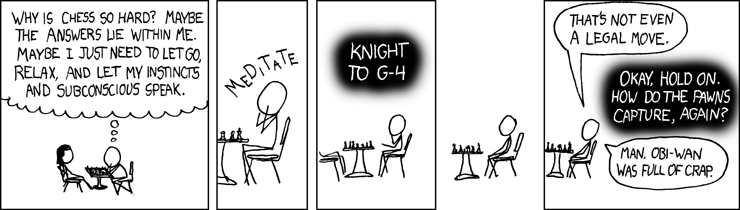
It's old news that George Bush thinks God speaks to him. I saw this comic today and I thought it was a perfect metaphor for what goes on in Bush's head. Just replace "instincts and subconscious" with "God" and "Obi-Wan" with "Billy Graham":


If only Bush were as smart as the stick figure. In actuality, Bush would insist NG4 is a legal move, would accuse any officials who disputed his move of being cowards, would modify the chess rulebook with a pen, would imply the editor of the rulebook is a traitor, and would replace all chess officials with members of his Texas staff.

Sean Hannity would broadcast interviews round-the-clock with a group called Chessplayers for Truth, The New York Times would feature an article on the front page called "Chess Rulebook Was Incorrect, Officials Say," by Michael Gordan, and FOX would display the text, "Are Liberals too Wussy to Play by the Rules?"

Thursday, February 15, 2007

Where is the grave-yard of dead gods?

"Did the Romans really believe in all those gods, Mom?"

That's what I asked when I was about 10. I wonder how long it will be before someone asks his mother if people really ever believed in Yahweh, Jesus, or Allah.

Via Ed Brayton, Mencken's "Memorial Service":

Where is the grave-yard of dead gods? What lingering mourner waters their mounds? There was a day when Jupiter was the king of the gods, and any man who doubted his puissance was ipso facto a barbarian and an ignoramus. But where in all the world is there a man who worships Jupiter to-day? And what of Huitzilopochtli? In one year-and it is no more than five hundred years ago-50,000 youths and maidens were slain in sacrifice to him. Today, if he is remembered at all, it is only by some vagrant savage in the depths of the Mexican forest. Huitzilopochtli, like many other gods, had no human father; his mother was a virtuous widow; he was born of an apparently innocent flirtation that she carried on with the sun. When he frowned, his father, the sun, stood still. When he roared with rage, earthquakes engulfed whole cities. When he thirsted he was watered with 10,000 gallons of human blood. But today [in 1921] Huitzilopochtli is as magnificently forgotten as Allen G. Thurman. Once the peer of Allah, Buddha, and Wotan, he is now the peer of General Coxey, Richmond P. Hobson, Nan Petterson, Alton B. Parker, Adelina Patti, General Weyler, and Tom Sharkey.

Speaking of Huitzilopochtli recalls his brother, Tezcatilpoca. Tezcatilpoca was almost as powerful: He consumed 25,000 virgins a year. Lead me to his tomb: I would weep, and hang a couronne des perles. But who knows where it is? Or where the grave of Quitzalcontl is? Or Tialoc? Or Chalchihuitlicue? Or Xiehtecutli? Or Centeotl, that sweet one? Or Tlazolteotl, the goddess of love? Or Mictlan? Or Ixtlilton? Or Omacatl? Or Yacatecutli? Or Mixcoatl? Or Xipe? Or all the host of Tzitzimitles? Where are their bones? Where is the willow on which they hung their harps? In what forlorn and unheard of hell do they await the resurrection morn? Who enjoys their residuary estates? Or that of Dis, whom Caesar found to be the chief god of the Celts? Or that of Tarves, the bull? Or that of Moccos, the pig? Or that of Epona, the mare? Or that of Mullo, the celestial jack-ass? There was a time when the Irish revered all these gods as violently as they now hate the English. But today even the drunkest Irishman laughs at them.

But they have company in oblivion: The hell of dead gods is as crowded as the Presbyterian hell for babies. Damona is there, and Esus, and Drunemeton, and Silvana, and Dervones, and Adsalluta, and Deva, and Belisama, and Axona, and Vintios, and Taranuous, and Sulis, and Cocidius, and Adsmerius, and Dumiatis, and Caletos, and Moccus, and Ollovidius, and Albiorix, and Leucitius, and Vitucadrus, and Ogmios, and Uxellimus, and Borvo, and Grannos, and Mogons. All mighty gods in their day, worshiped by millions, full of demands and impositions, able to bind and loose-all gods of the first class, not dilettanti. Men labored for generations to build vast temples to them-temples with stones as large as hay-wagons. The business of interpreting their whims occupied thousands of priests, wizards, archdeacons, evangelists, haruspices, bishops, archbishops. To doubt them was to die, usually at the stake. Armies took to the field to defend them against infidels: Villages were burned, women and children were butchered, cattle were driven off. Yet in the end they all withered and died, and today there is none so poor to do them reverence. Worse, the very tombs in which they lie are lost, and so even a respectful stranger is debarred from paying them the slightest and politest homage.

What has become of Sutekh, once the high god of the whole Nile Valley? What has become of:

Resheph
Anath
Ashtoreth
El
Nergal
Nebo
Ninib
Melek

Ahijah
Isis
Ptah
Anubis
Baal
Astarte
Hadad
Addu

Shalem
Dagon
Sharrab
Yau
Amon-Re
Osiris
Sebek
Molech?

All these were once gods of the highest eminence. Many of them are mentioned with fear and trembling in the Old Testament. They ranked, five or six thousand years ago, with Jahveh himself; the worst of them stood far higher than Thor. Yet they have all gone down the chute, and with them the following:

Bilé
Ler
Arianrod
Morrigu
Govannon
Gunfled
Sokk-mimi
Memetona
Dagda
Robigus
Pluto
Ops
Meditrina
Vesta
Tilmun
Ogyrvan
Dea Dia
Ceros
Vaticanus
Edulia
Adeona
Iuno Lucina
Saturn
Furrina
Vediovis
Consus
Cronos
Enki
Engurra
Belus
Dimmer
Mu-ul-lil
Ubargisi
Ubilulu
Gasan lil
U-dimmer-an-kia
Enurestu
U-sab-sib

Kerridwen
Pwyll
Tammuz
Venus
Bau
Mulu-hursang
Anu
Beltis
Nusku
U-Mersi
Beltu
Dumu-zi-abzu
Kuski-banda
Sin
Abil Addu
Apsu
Dagan
Elali
Isum
Mami
Nin-man
Zaraqu
Suqamunu
Zagaga
Gwydion
Manawyddan
Nuada Argetlam
Tagd
Goibniu
Odin
Llaw Gyffes
Lleu
Ogma
Mider
Rigantona
Marzin
Mars
Kaawanu

Ni-zu
Sahi
Aa
Allatu
Jupiter
Cunina
Potina
Statilinus
Diana of Ephesus
Nin-azu
Lugal-Amarada
Zer-panitu
Merodach
U-ki
Dauke
Gasan-abzu
Elum
U-Tin-dir-ki
Marduk
Nin-lil-la
Nin
Persephone
Istar
Lagas
U-urugal
Sirtumu
Ea
Nirig
Nebo
Samas
Ma-banba-anna
En-Mersi
Amurru
Assur
Aku
Qarradu
Ura-gala
Ueras

You may think I spoof. That I invent the names. I do not. Ask the rector to lend you any good treatise on comparative religion: You will find them all listed. They were gods of the highest standing and dignity-gods of civilized peoples-worshiped and believed in by millions. All were theoretically omnipotent, omniscient, and immortal. And all are dead.